Welcome The Dimopoulos Group
comprises an international team of scientists, that study mosquitoes which transmit human pathogens such as malaria parasites, and
arboviruses, as part to their scientific careers, postdoctoral training, or PhD and master degree thesis research.
Mosquito transmitted diseases represent some of the world’s most serious public health
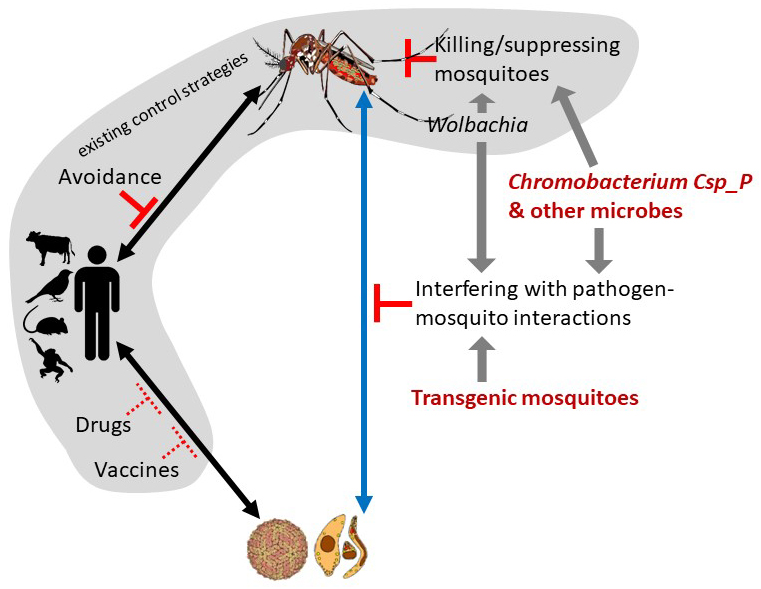
problems. The current control strategies for these
diseases are mostly based on mosquito
killing or avoidance, and are insufficient to limit their
spread and final elimination.
Our research program is broadly
focused on the biology of mosquito vector competence for
malaria and dengue. Our long-term goal is
to develop novel disease intervention strategies based
on blocking the pathogens in the mosquito, and killing
mosquitoes. The
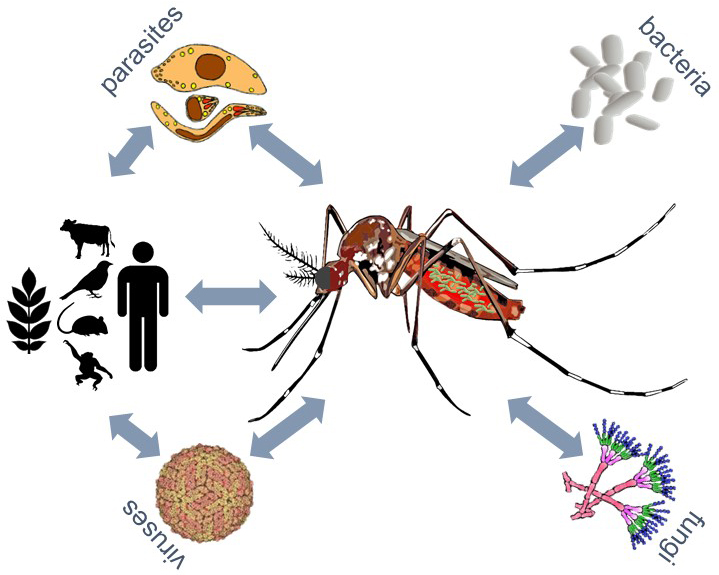
overarching theme is the reciprocal molecular
interactions between the pathogens, the mosquito’s
innate immune system and microbiota.
The mosquito has
evolved into a powerful biological model for the study
of host-pathogen interactions, and how these are
affected by the immune system and microbiota. Our
research areas comprise several synergistically
interacting projects, which combine molecular biology,
biochemical, and functional genomic and genetic analyses
of mosquitoes and microbes with parasite and viral
infection models.
While our main focus is on the basic
biology of these systems, our projects also address
translational aspects related to their application in
innovative vector-borne disease control.
Department of Molecular Microbiology
& Immunoogy Johns Hopkins Malaria Research
Institute Bloomberg School of Public Health Johns Hopkins University